Grain moisture meters
In-line moisture meters FIZEPR‑SW100.1x are designed for monitoring grain drying in grain dryers, but are also used for measuring moisture content of grain and grain products stored in bunkers. The high operating temperature of the sensors allows them to be integrated directly into grain drying equipment. For example, only in ASM‑AGRO grain dryers (Barnaul, Russia) more than 300 FIZEPR‑SW100 moisture meters have been installed.
Advantages of FIZEPR-SW100 in-line moisture meters
- ✓ High accuracy
- ✓ Temperature compensation
- ✓ Self cleaning by grain flow
- ✓ High operating temperature capability
- ✓ Easy installation
- ✓ Made of stainless steel AISI 321
- ✓ 4–20 mA and RS-485 Modbus RTU
Controllable products: grain, flour, groats, seeds, compound feed and other agricultural products. When measuring grain moisture, unlike measuring inorganic bulk materials, it is extremely important that the temperature of the material being measured is taken into account. All FIZEPR‑SW100 moisture meters are equipped with temperature sensors for the material being measured. FIZEPR‑SW100 moisture meters intended for grain control contain calibrations for different types of grain products, which take into account the product temperature.
 FIZEPR‑SW100.10.21 grain moisture meter
FIZEPR‑SW100 moisture meters are equipped with standard interfaces (4...20 mA, RS‑485 MODBUS RTU) and can be connected to automated control system (ACS).
The moisture analyzers are included in the State Registers of Measuring Instruments: in Russia – certificate RU.C.31.001A No. 56698. The general catalogue for moisture meters for bulk and paste‑like materials is given here: Catalogue.
By measurement principle, FIZEPR‑SW100.1x moisture analyzers belong to microwave dielcometers. A feature of the analyzers is the direct method of measuring dielectric permittivity, which provides the highest possible accuracy in moisture measurement. All FIZEPR‑SW100 moisture meters are equipped with built‑in temperature sensors. Provision is made for connecting an external temperature sensor of Pt100 type with a four‑wire connection scheme. Correction of measurement results for grain temperature has significantly improved measurement accuracy. The advantages of the moisture meters also include the large volume of simultaneously controlled material, which eliminates errors associated with non‑uniform moisture distribution in the material. In terms of their characteristics, FIZEPR‑SW100 moisture meters have no analogues.
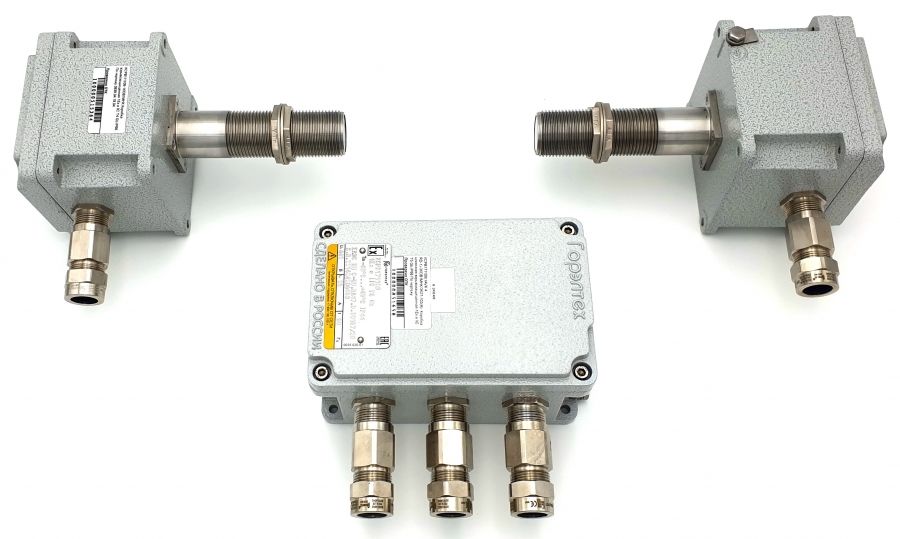
The moisture meters consist of an electronic unit and a sensor. The sensor design features exceptional strength, resistance to mechanical loads, impacts, and abrasion by abrasive materials. All sensor versions are sealed. The sensor bodies are made of stainless AISI 321. The warranty period for FIZEPR‑SW100 moisture meters is 24 months.
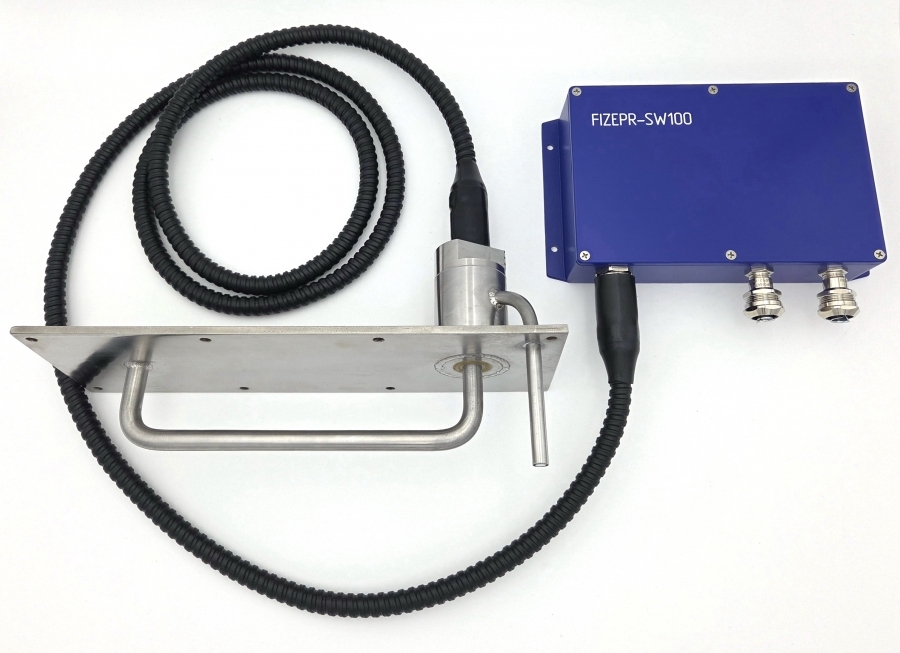
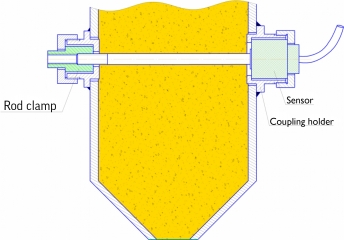
Grain product moisture meters are supplied in several versions, differing in the sensor design, with all moisture meters having identical, interchangeable electronic units. A common feature characterising the FIZEPR‑SW100.1x series moisture meters is that the sensors contain two electrodes, one of which is in the form of a rod, and the second electrode is either a plate, or a metal wall of the bunker, or a second rod. The figures below show two versions of FIZEPR‑SW100.10.6 (10.21) and FIZEPR‑SW100.10.4 (10.41) sensors.
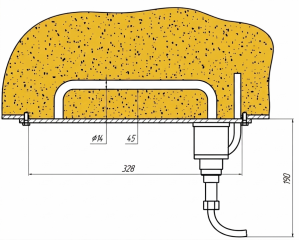 FIZEPR‑SW100.10.6 (10.21)
  FIZEPR-SW100.10.4 (10.41)
1. Sensors for cross-flow and conveyor grain dryers (wall‑mounted)
1.1. Models FIZEPR‑SW100.10.6 and FIZEPR‑SW100.10.21
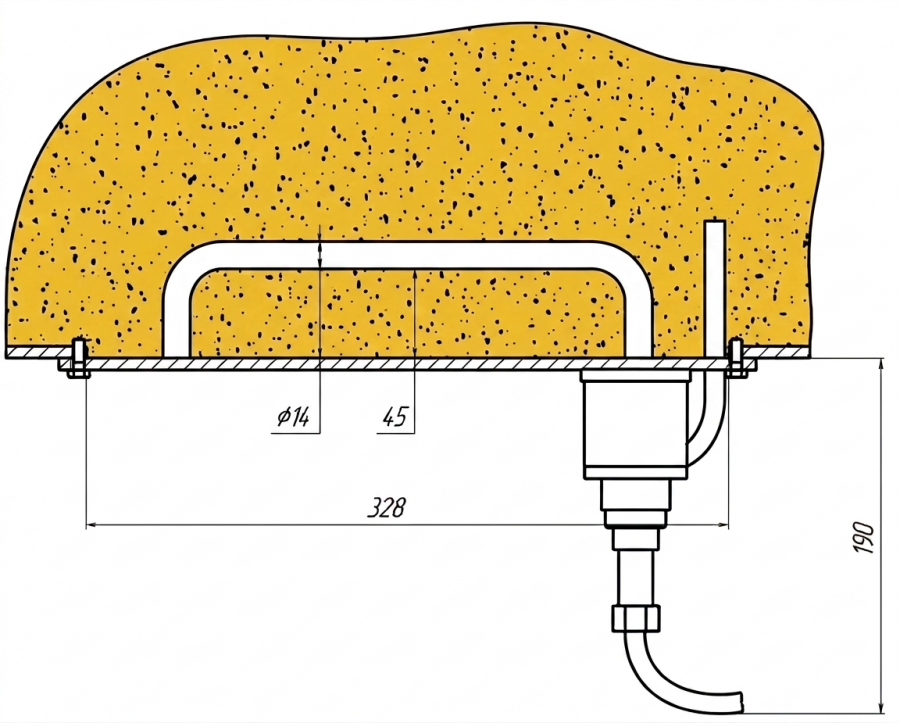
These sensors are made of stainless steel AISI 321 and contain a U‑shaped probe fixed on a shield. As can be seen from the photos of these two sensors, the FIZEPR‑SW100.10.6 sensor has only one U‑shaped probe on the shield; the volume of grain controlled by this sensor is about 10 litres. The FIZEPR‑SW100.10.21 sensor, also widely used in grain dryers, has a second U‑shaped rod installed near the probe and parallel to it, unlike the 10.6 version. This second rod acts as a screen and limits (as if cuts off on one side of the probe) the sensing area. In some cases, when the grain layer is not high enough, this improves measurement accuracy.
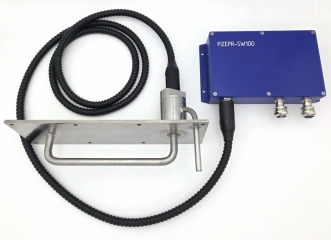 FIZEPR‑SW100.10.6 grain moisture meter
 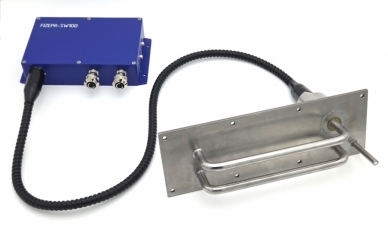 FIZEPR‑SW100.10.21 grain moisture meter
These sensors are widely used in conveyor and cross-flow grain dryers. In cross-flow grain dryers, as well as in conveyor dryers, these sensors are usually installed directly on the dryer wall, for which a rectangular opening of (310…315) x (80…85) mm is made in the wall. The sensor shield is mounted on the outside of the grain dryer so that the probe is inside and completely immersed in the grain. The volume of space controlled by the sensor, including the gap between the probe and the sensor shield and the entire volume around the probe at distances of up to 10‑15 cm from it, must be completely filled with the grain being measured. The sensor shield is attached to the grain dryer wall with screws or self‑tapping screws. The photo below shows the installation of the FIZEPR‑SW100.10.21 sensor on the wall of a conveyor grain dryer.
PLEASE NOTE: the screening probe of the 10.21 sensor is installed above (above the measuring probe), which ensures accurate measurement even when the grain layer only slightly covers the shielded probe. In cross-flow dryers, these sensors are recommended to be mounted with the probe oriented vertically along the grain flow.
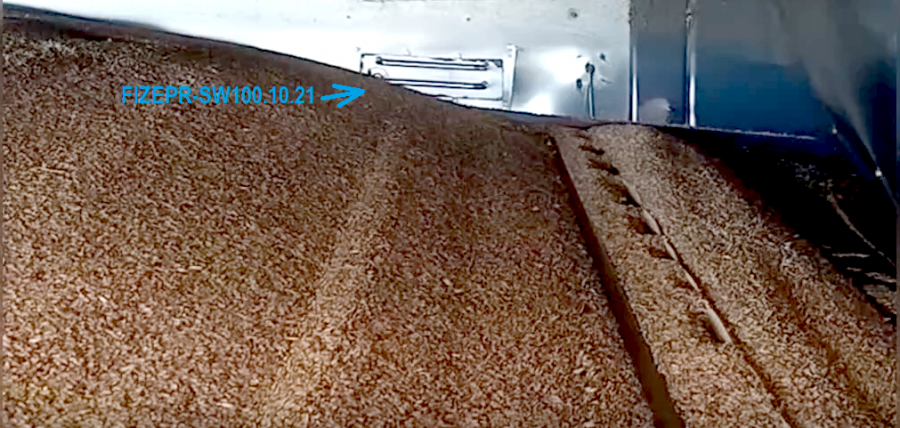 The FIZEPR‑SW100.10.21 sensor is mounted on the wall of a belt grain dryer.
In conveyor grain dryers, FIZEPR‑SW100.10.21 and FIZEPR‑SW100.10.6 sensors can also be mounted on brackets. Two bracket mounting options, differing in design, are shown in the figures below. Mounting the sensor on a bracket improves its filling with grain. Also, on a bracket in conveyor grain dryers, the FIZEPR‑SW100.11.82 sensor can be installed. This version is a modification of the FIZEPR‑SW100.11.81 for mixed-flow grain dryers.
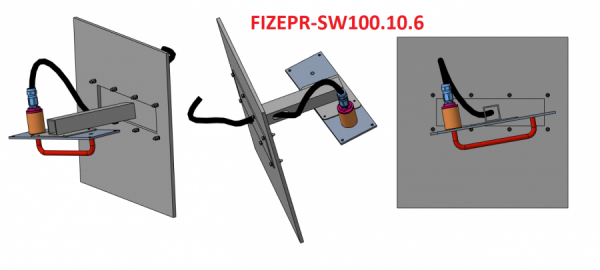 FIZEPR‑SW100.10.6 (10.21) sensor on a bracket – mounting option 1 in a grain dryer
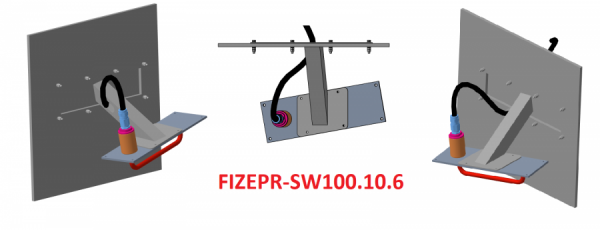 FIZEPR‑SW100.10.6 (10.21) sensor on a bracket – mounting option 2 in a grain dryer
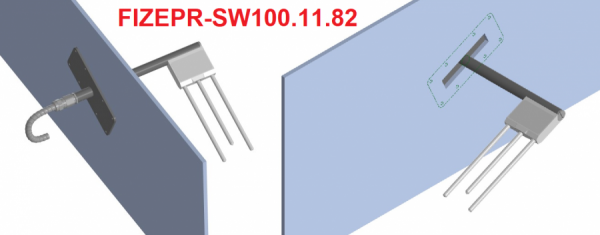 FIZEPR‑SW100.11.82 sensor in a belt grain dryer
1.2. High‑temperature modifications (above 140°C)
For use at temperatures above 140°C (when the sensors are exposed to a hot air flow up to 180°C), modifications of these sensors are available: FIZEPR‑SW100.10.61 and FIZEPR‑SW100.10.211. In these modifications, the measuring cell of the sensor is made as a separate element, remote about 15 cm from the sensor shield (see figure below).
 FIZEPR‑SW100.10.61 sensor for temperatures above 140°C
2. Sensors for mixed-flow grain dryers
2.1. Model FIZEPR‑SW100.10.8
For mixed-flow‑type grain dryers, the FIZEPR‑SW100.10.8 sensor has been developed. The sensor is attached to the wall of the mixed-flow grain dryer, and the sensor base rests against the air duct box. The dimensions of the sensitive element (300 x 100 x 60 mm) allow it to be inserted between the air ducts of any dryers. This arrangement ensures stable filling of the sensor volume with grain. In this moisture meter, the temperature sensor (Pt100 thermistor, 4‑wire) is installed on the sensor housing made of stainless steel sheet. This solution has significantly reduced the inertia of grain temperature measurement and improved moisture measurement accuracy.
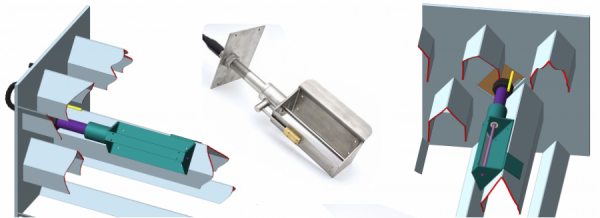 FIZEPR‑SW100.10.8 moisture meter sensor in a shaft grain dryer
2.2. Model FIZEPR‑SW100.11.81
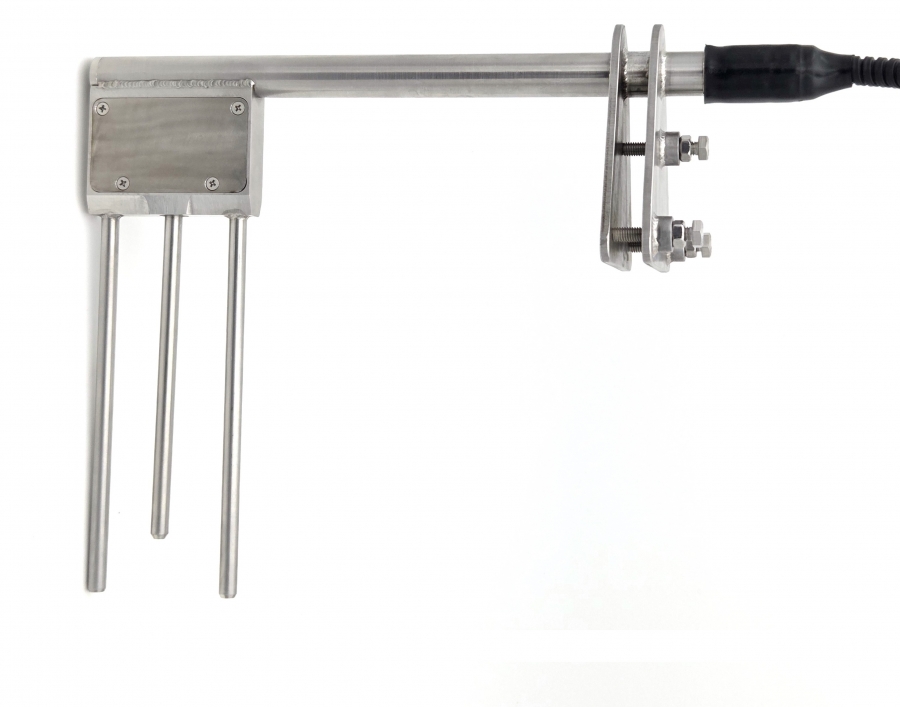
Production of FIZEPR‑SW100.11.81 moisture meters for mixed-flow grain dryers has been launched. The sensor design largely repeats the basic model FIZEPR‑SW100.11.41, but differs in the mounting method. The instrument is inserted into the air duct window and fixed on the dryer wall with a clamp. This solution allows easy relocation of the moisture meter when searching for the optimal control point. A temperature sensor built into one of the side pins provides virtually inertia‑free monitoring of grain heating, which is critical for high moisture measurement accuracy. This modification, like all FIZEPR‑SW100 series devices, is made entirely of food‑grade stainless steel AISI 321, including mounting elements.
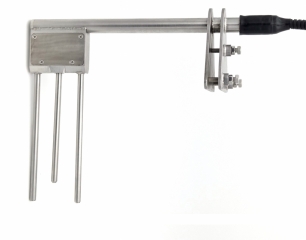 FIZEPR‑SW100.11.81 grain moisture meter for shaft dryers
  Installation of the FIZEPR‑SW100.11.81 sensor in the air duct opening of a shaft dryer
3. Universal sensor for bracket mounting (G1 pipe)
The FIZEPR‑SW100.11.41 moisture meter is universal; its probe is made in the form of a fork of two pins. The volume of grain controlled by this sensor is about 1 litre. The sensor design assumes its mounting on a bracket – a pipe G1. The immersion depth of the sensor in grain is determined by the bracket design. When ordering, the delivery set may include all necessary mounting hardware.
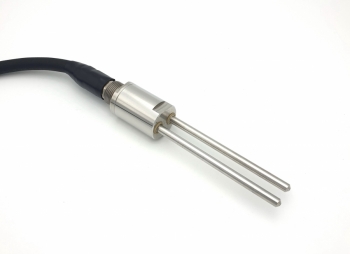 FIZEPR‑SW100.11.41 moisture meter sensor for grain dryers
4. Sensor for bunkers (between walls)
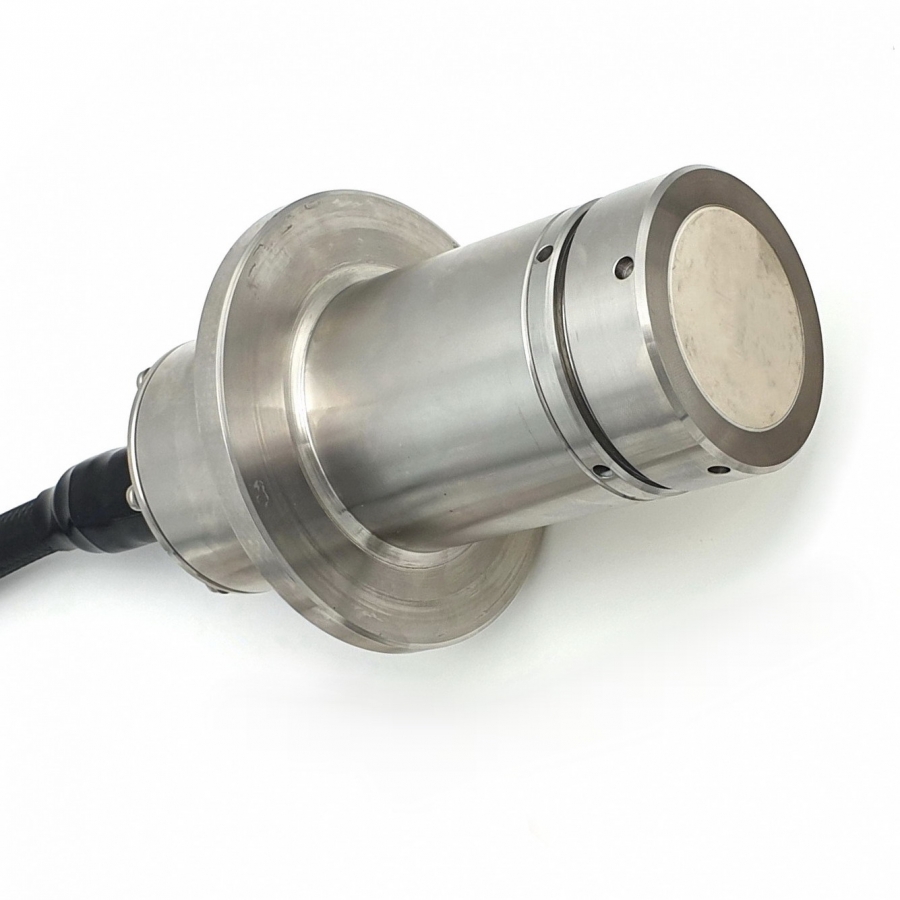
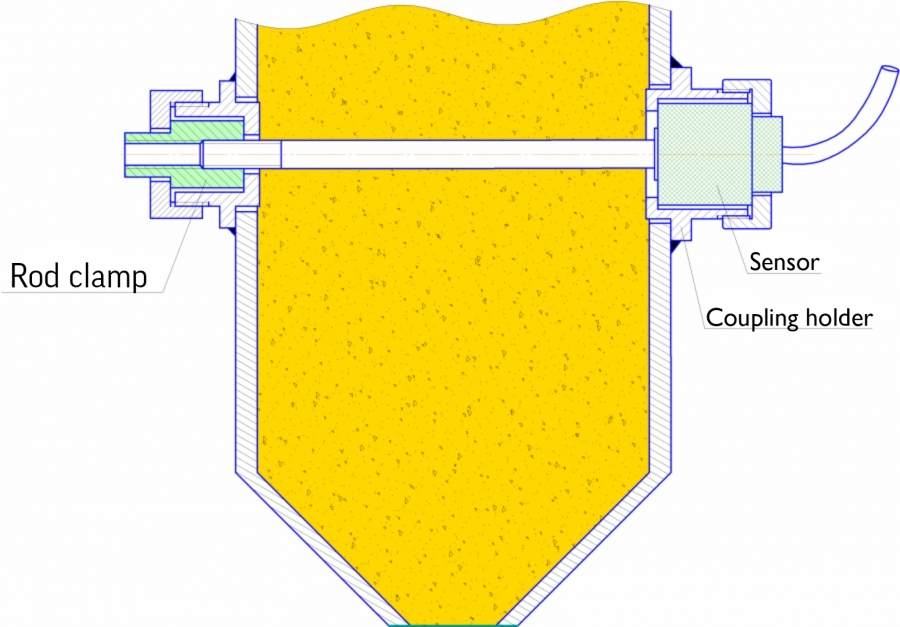
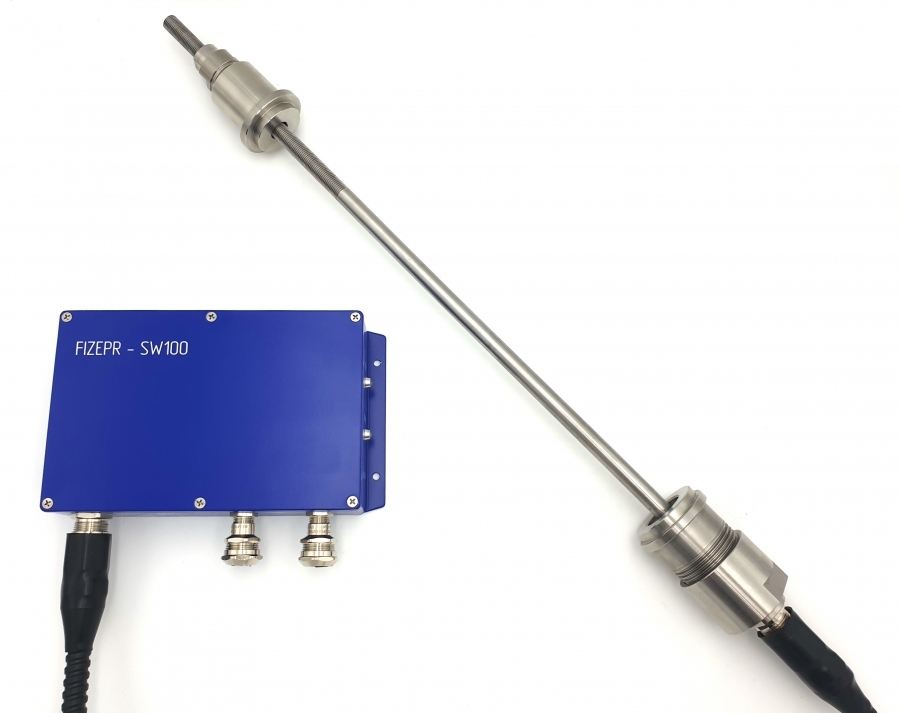
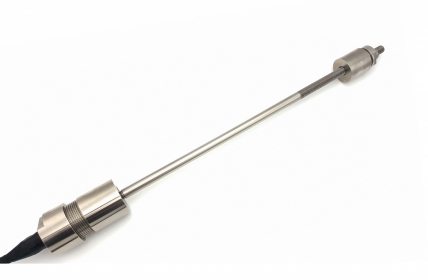
The FIZEPR‑SW100.10.4 (FIZEPR‑SW100.10.41) sensor is made as a straight rod, the ends of which are fixed on opposite walls of the bunker through special couplings. The second (screen) electrode of this sensor is the metal walls of the bunker. The sensor provides control of a larger volume of bulk material (from tens to hundreds of litres), due to which non‑uniform moisture distribution over the bunker volume does not affect the measurement results.
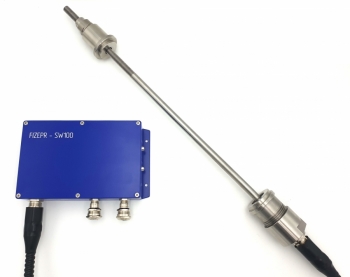 GRAIN MOISTURE METER FIZEPR-SW100.10.41
Features of Grain Moisture Measurement with In‑Line Moisture Meters.
Factors Affecting Accuracy.
Measuring grain moisture in a flow is a complex task that requires taking into account many factors. All the factors listed below equally apply to any in‑line moisture meters used in grain dryers and bunkers, including FIZEPR‑SW100.
The factors can be divided into 3 groups.
Group 1. Factors due to the specifics of measuring any bulk materials
(these factors are described in detail in the operating manual for FIZEPR‑SW100 moisture meters)
- Incomplete filling of the sensor with grain. The cause may be not only an insufficient grain level at the sensor installation site, but also a high velocity of material movement, as well as ingress of foreign objects (debris) that prevent grain from passing through the sensor cavity.
- Unrepresentative measurement. The reason for unrepresentative measurement may be the location of the sensor in places of the drying plant (bunker) where grain is not renewed, resulting in the measured moisture not matching the moisture of the main grain flow.
- Inconstant bulk density of grain in the sensor measurement area, leading to changes in the amount of grain in the volume controlled by the sensor and, accordingly, changes in the amount of water contained in that volume, which the moisture meter measures. Bulk density fluctuations may be caused by changes in the grain level above the sensor. This is especially noticeable when measuring in small bunkers. For example, if the grain level above the sensor varies from 10 to 150 cm, moisture readings may differ by 2‑3%.
- Difference between the bulk density of grain in the sensor under actual operating conditions and the bulk density of grain filling the sensor during calibration of the moisture meter in laboratory conditions.
All supplied FIZEPR‑SW100 moisture meters have initial calibrations for various grain crops. However, the bulk density of grain (even if it is constant) at each specific sensor installation site may differ from the bulk density of grain filling the sensor during calibration. Therefore, when putting the moisture meter into operation, some adjustment of the initial calibrations may be required in accordance with the results of laboratory measurements (by the drying method). This adjustment is performed either by changing the calibration characteristics, or by introducing a user offset into the calibration characteristic.
- Incorrect initial calibration of the sensor in air. As a rule, for FIZEPR‑SW100.10.6 and FIZEPR‑SW100.10.21 sensors, the calibration frequency "for an empty resonator" depends little on the sensor installation site, but there may be cases where, depending on the installation site and proximity of metal objects to the sensor, the initial calibration should be corrected.
Group 2. Factors associated with the specifics of measuring grain itself
The fact is that FIZEPR‑SW100 moisture meters (like practically all other moisture meters used for operational control of grain) are, by their principle of operation, dielectric permittivity meters. The dielectric parameters of grain, in addition to water content, depend on many factors, including even the region where the grain was grown.
Let us list these factors:
- The dielectric parameters of grain depend on the grain variety, its impurity content, and fraction size. Therefore, for specific parameters of the grain product being monitored, a separate calibration or adjustment offset is required. If the impurity content and fraction sizes of the grain change unpredictably, it is impossible to account for such changes.
- The effect of grain temperature on its dielectric permittivity. Unlike inorganic substances, this effect is extremely large.
As an example, let us show the effect of soybean temperature on the measurement result by any accurate dielcometric moisture meter. Consider the case when soybean with 10% moisture fills a moisture meter whose calibration corresponds to a soybean temperature of 10°C and does not change (i.e., the moisture meter thermometer is "stuck" at 10°C):
- at a soybean temperature of +10°C, the moisture meter will show 10.00% moisture;
- if the same soybean sample is heated (while maintaining moisture) to +48°C, the moisture meter will show 15.25% moisture;
- if the same soybean sample is cooled (without changing the water fraction) to +5°C, the moisture meter will show 6.24% moisture.
As can be seen from this example, the absence of grain temperature compensation in the moisture meter leads to a moisture measurement error exceeding 50% (relative units).
PLEASE NOTE: all moisture meters manufactured by Design Bureau Fizelektronpribor, regardless of the year of manufacture, are equipped with temperature sensors. To date, a large amount of research has been carried out, as a result of which new calibrations for grain moisture meters with more accurate temperature compensation have been prepared, which has significantly improved the accuracy of drying process control in grain dryers. These calibrations have been prepared for almost all types of grains in Russia.
Under the post‑warranty support program, Design Bureau Fizelektronpribor, provides updated calibrations free of charge and assists with their installation regardless of the moisture meter production date.
- Accuracy of grain temperature measurement. All FIZEPR‑SW100 moisture meter sensors are equipped with built‑in thermometers – Pt100 thermistors (four‑wire connection). Since the thermistors are built into the measuring probe, which has thermal inertia, depending on the dryer design and the current temperature gradient, temperature measurement may be performed with a time lag, which leads to additional errors in grain moisture measurements. This error will occur during rapid changes in grain temperature or in case of a large temperature difference between the grain and the moisture meter sensor probe. If these factors strongly affect measurements, an external temperature sensor should be used instead of the built‑in thermistor, similar to the standard temperature sensors installed on dryers for process monitoring. The external temperature sensor is connected to the electronic unit of the moisture meter instead of the built‑in thermistor. As an external temperature sensor, for example, measuring instruments from "Owen" can be used: thermometer (thermal resistance) DTS134‑RT100.V4.150/4 or dual thermometer 2DTS134‑RT100.V4.150/4.
Group 3. Factors related to the specifics of control measurements using hand‑held express moisture meters
The third group of factors is related to the specifics of control measurements of moisture using hand‑held express moisture meters, which users use as reference instruments and on the basis of which users draw conclusions about measurement quality:
- Unrepresentativeness of the taken sample. As a rule, moisture is distributed unevenly over the grain volume. Fluctuations in grain moisture depending on the sampling point can be +/- 1% or even more. Therefore, to assess the accuracy of the moisture meter, at least five samples should be taken, and precisely from the volume that the moisture meter measures. To check the readings of FIZEPR‑SW100.10.6 (10.21) moisture meters, it is advisable to take samples no further than 10 cm from the sensor.
- Error of the control measurement of the taken sample. The most accurate method for measuring water content in a taken sample is the gravimetric method (drying method). The measurement should be performed using a drying oven or an automatic gravimetric moisture analyzer.
Unfortunately, in most cases, users on site use hand‑held dielcometric express moisture meters such as Wile‑55 to determine the "exact" moisture value. The accuracy of these moisture meters must be checked for each crop using the drying method, taking into account the sampling recommendations given in point 9. These moisture meters have a specific feature: the temperature of the taken grain sample must be equal to the temperature of the housing of these instruments, because due to the small sample size, the built‑in temperature sensor actually measures the temperature of the housing into which the grain is poured. And what is also important, the temperature of the instrument must be within the limits specified in the instruction manual.
From our experience: users of Wile‑55 usually do not pay attention to the need to bring the temperature of the taken grain sample to the temperature of the instrument and both of them to the recommended measurement temperature. Please note: Wile‑55 moisture meters and all similar ones are dielcometric meters and, accordingly, the effect of temperature on measurement results is also very large. It is also important to note here that users usually do not take into account that grain impurity content also affects the readings of these moisture meters. We believe that the use of hand‑held moisture meters such as Wile‑55 as a reference measuring instrument is a very questionable solution. For these purposes, gravimetric moisture analyzers should be used, or, as a last resort, bench‑top dielcometric moisture meters such as Wile‑200 (provided that the requirements of the Wile‑200 operating instructions regarding the temperature regime of measurements are met).
All the above factors determining grain moisture measurement accuracy equally apply to all types of in‑line moisture meters existing in the world.


 English
 Русский